Benson, James Set Up November Showdown for Michigan Governor
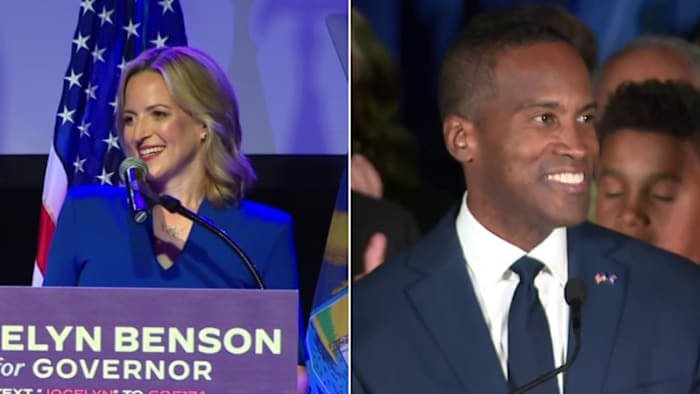
Jocelyn Benson and John James won their parties' primaries Aug. 4, setting up a November matchup to decide who succeeds Gov. Gretchen Whitmer and whether Republicans can retake the governor's office for the first time since 2014.
Michigan's governor's race has its two finalists.
Democrat Jocelyn Benson and Republican John James won their primaries on Aug. 4, setting up a November matchup to decide who succeeds Gov. Gretchen Whitmer.
Benson, the state's secretary of state, defeated Genesee County Sheriff Chris Swanson in the Democratic primary, taking more than 83% of the vote. James, a U.S. congressman, had a tougher path, edging past businessman Perry Johnson with roughly half the vote. Johnson said he put $30 million of his own money into the race trying to stop him.
The general election is set for Nov. 3, 2026.
For Benson, the primary result wasn't much of a contest. She's framing her run for governor as a continuation of what she calls a turnaround at the secretary of state's office, arguing that record shows she can manage state government effectively from her first day in the job.
"I think all citizens want leaders who can get things done," Benson said. "We need a governor who can get to work on day one to deliver results, to lower costs. And I'm the only candidate with a plan to do that and a track record of delivering results."
James, who picked up President Donald Trump's endorsement during the Republican primary, said his win by double digits proves voters want a candidate who avoids political fighting for its own sake.
"The biggest lessons that I learned is that the people want the same message," James said. "They want somebody who's going to deliver for them, who's gonna put their concerns first, and ultimately, I won by a majority and by double digits because people are rejecting the politics of bile and division."
Trump carried Michigan in 2024, and his connection to James is likely to be a central theme of the fall campaign. Asked directly how much the general election would turn into a referendum on the president, Benson pointed to her own record of pushing back against him.
"I have focused on what the people of Michigan need, including standing up to the president when he tries to overturn our elections or otherwise pressure me to turn over private citizens' data," Benson said. "I'll say no."
James, for his part, said he intends to keep the campaign trained on state issues rather than national fights. "Focusing on the needs of the people is what I've been doing from the very beginning," he said. "It's why I was able to win the primary by such a large margin and is part of the reason why I'm excited for the coalition that we're currently building here in the state of Michigan."
The party hasn't won a Michigan governor's race since Rick Snyder's reelection in 2014, meaning James is trying to break more than a decade of Democratic control of the office. Benson, meanwhile, has to make the case for continuity after eight years of Democratic governors while presenting herself as a fresh face rather than simply an extension of Whitmer's administration, which she cannot run for again due to term limits.
James faced a far rockier road to the nomination than Benson did. Johnson's self-funded campaign turned the Republican primary into a costly fight, but James still walked away with a comfortable double-digit margin, which he's pointing to as evidence of a coalition he can carry into November.
Both campaigns say they're open to debating. James said his team has proposed five debates and has locked in agreements for three so far. No dates have been announced.
With the primaries settled, both candidates said they plan to spend the coming months raising money and building their campaign organizations ahead of the general election, set for Nov. 3, 2026.