Waterford toddler with rare CACNA1E disorder keeps insurance coverage for gene therapy
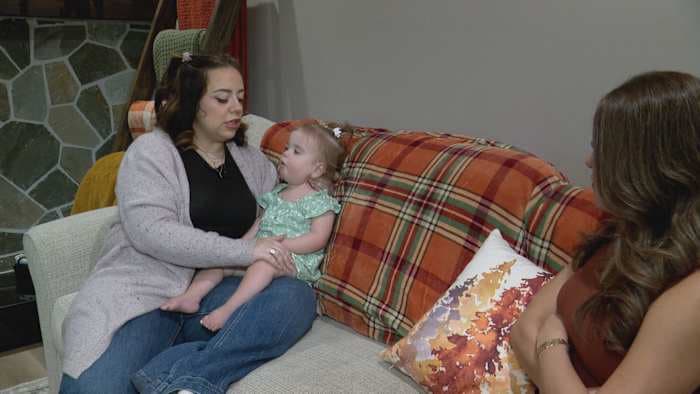
Kayleigh Dunn's mornings in Waterford include crushing pills into water, measuring doses and checking a feeding tube for her 1-year-old daughter, Lorelei. The routine keeps Lorelei stable while the family waits on a treatment that nearly became out of reach earlier this year because of an insurance dispute.
Lorelei has CACNA1E, a genetic disorder so rare that only about 150 people worldwide are known to have it. Her specific mutation is shared by roughly 30 of them. The disorder causes a seizure disorder, severe hypotonia, and an inability to hold up her head or support her own trunk. Complications with eating led to the feeding tube she now relies on.
"Because of that, it causes her to have a seizure disorder," Dunn said. "She has severe hypotonia. She cannot hold her head up. She has no trunk support. Because of some complications we've had with eating, she does have a feeding tube."
Dunn got the diagnosis when Lorelei was just a few months old. She said doctors initially told her the family's options were scarce, close to nonexistent. That changed when they connected with a neurologist at University of Michigan Medicine who told them about a gene therapy that could help Lorelei.
In May, the family's insurance coverage was at risk of being canceled. That would have forced them to find a new neurologist and potentially move out of state to keep pursuing treatment. Dunn said no other neurologist in Michigan was willing to take on the case.
"If we had lost our coverage and we were going to have to move, see a different neurologist," Dunn said. "There was no neurologist in the state of Michigan that we found that would be willing to take this on. This is a big ... to do what we want to do, they have to agree to a case study. It means long hours, extra shifts."
After the family's situation was reported in May, the insurance coverage was extended. That reversal kept Lorelei's treatment plan intact, and she remained able to see the University of Michigan neurologist who had agreed to take on the case study.
Now that the insurance issue is resolved, the Dunns are focusing on raising awareness of CACNA1E. September 6 marked CACNA1E Awareness Day, and the family used the day to talk about why research funding and public recognition of the disorder matter beyond their own household.
With so few documented cases worldwide, research into CACNA1E depends heavily on families like the Dunns making noise about their children's diagnoses. Case studies, like the one Lorelei is now part of through University of Michigan Medicine, are often the main way treatments for ultra-rare conditions get tested at all, since the patient population is too small to support large clinical trials of the kind pharmaceutical companies typically run for more common diseases.
Dunn said she never expected to become versed in the details of one of the world's rarest genetic mutations. She said Lorelei's day-to-day needs, the seizures, the physical limitations, the feeding tube, are only part of what her family manages now.
"She's proven time and time again that she is not defined by her mutation, but it's my life and it's tough. It's tough, right," Dunn said.
The family has set up a fundraising page to help cover costs tied to Lorelei's care and treatment. For now, the insurance coverage that once seemed at risk is holding, and Lorelei remains enrolled in the case study with her University of Michigan neurologist as the family continues pushing for wider awareness of CACNA1E.